Have you ever felt like a ghost in a crowded room?
I have.
It’s that strange moment when you’re physically present but emotionally invisible almost as if you’re standing behind a pane of glass while everyone else mingles on the other side. You watch the laughter, the inside jokes, the easy familiarity, and you wonder if anyone will notice the quiet figure in the corner.
I’ve always been a bit jealous of the people who can glide into a group like a bird joining a flock. Others, especially us introverts, move more like deer at the edge of a clearing, cautious, hoping for a sign that it’s safe to step in.
This longing isn’t weakness. It’s wiring. Baumeister and Leary once argued that belonging is as essential as water or food. We don’t just want connection, we need it. Belonging is the emotional oxygen that keeps us alive. Somewhere along the way, our relationship with connection got tangled up with our relationship to technology.
Back in my English undergrad days, we studied thinkers like Fish, Pirsig, Derrida, and Foucault, people who loved to peel back the layers of meaning in everyday life. During one of our debates, we found ourselves discussing the virtues and vices of technology. What struck me then, and still strikes me now, is how technology has always been a double-edged sword. It improves the human experience, yet it simultaneously creates distance.
Merriam-Webster defines technology as “a manner of accomplishing a task, especially using technical processes, methods, or knowledge.” Our ancestors discovered fire, created clothing, and built shelter. These innovations made life a little safer and more comfortable, but they also began to create subtle separations within the tribe. Comfort can sometimes come at the cost of connection.
This pattern becomes even clearer when we look at more recent history. Imagine a summer evening in the 1800s: children playing outside, neighbors gathered on front porches, conversations drifting like fireflies through the warm air. Community was not an event but a natural rhythm.
Then electricity arrived, and with it, the radio. Families moved indoors to gather around a glowing box of sound. The porch, once a social hub, grew quieter. The television deepened this shift, drawing people further inside. The personal computer, the internet, and now AI have each added new rooms to the house of modern life, but with every new room, another door quietly closed.
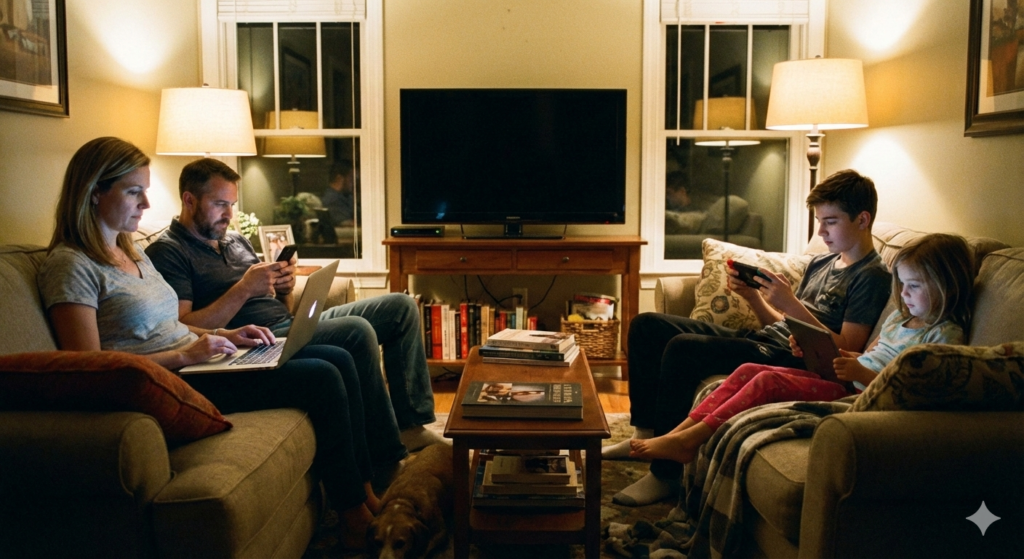
Today, it’s common to see a family sitting together in the same living room while inhabiting entirely separate worlds. Parents scroll through emails, a daughter navigates social media, a son battles digital opponents. They share physical space but not emotional presence. The irony is striking: we search our screens for belonging while the people we long for are often sitting just a few feet away.
This is not an argument against technology. Like fire, technology can warm or burn depending on how we use it. It is neither inherently good nor inherently harmful. It is a tool, capable of connection, creativity, and convenience; however, it’s also capable of distraction and quiet disconnection if left unchecked.
The challenge, then, is not to reject technology but to relate to it intentionally. If belonging is as essential as Baumeister and Leary suggest, then we must protect the spaces where belonging grows. We must treat technology like a campfire: something that can bring us together when used wisely, but something that can blind us to one another if we stare into it too long.
As we move into 2026, the invitation is simple:
Be deliberate.
Set boundaries.
Look up.
Notice the people in the room with you.
Belonging doesn’t happen by accident. It happens when we choose connection – again and again, on purpose.
References:
Merriam-Webster.com/dictionary/technology
Leave a Reply