Category: Leadership

For men carrying both worlds at once — closing the gap between who you are at work and who you are at home, and leading without losing yourself in the process.

  • A Father’s Competitive Edge

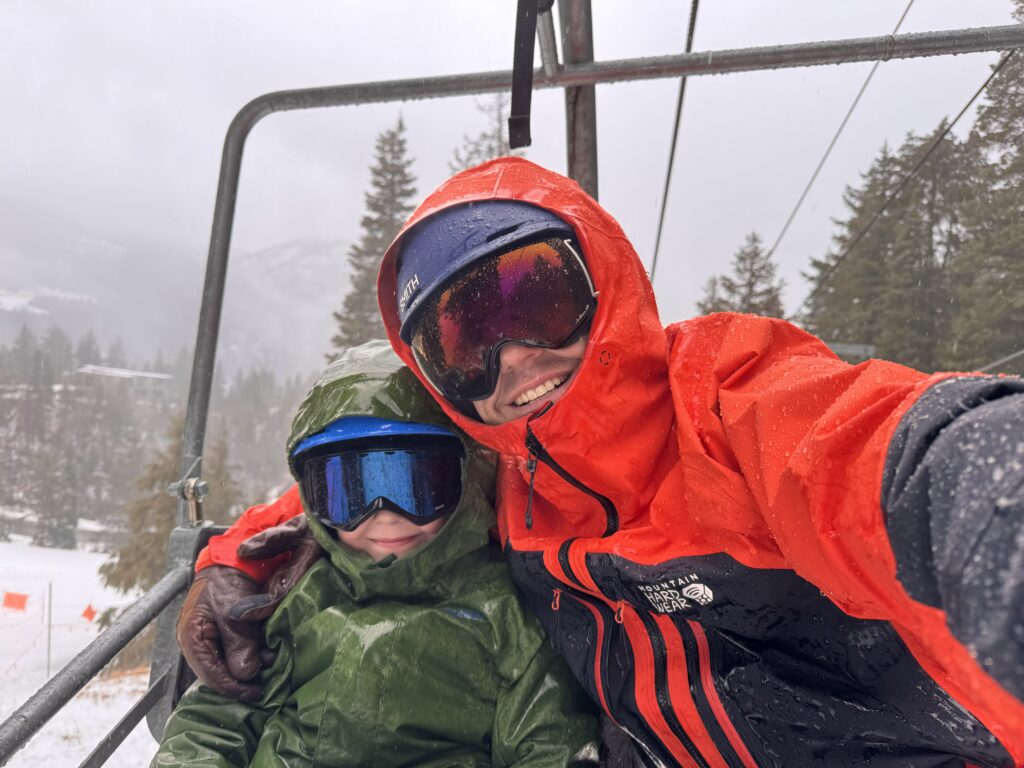
    A father and son ride a ski lift together, sharing time outdoors and building connection through a powerful winter experience.

    The Old Story of Strength

    Most fathers assume their competitive edge comes from the same places the world rewards: strength, productivity, discipline, and the ability to push through discomfort without flinching. I believed that for a long time. It’s what I was taught and what I tried to live up to.

    What I See in Men When the Armor Comes Off

    But the longer I do this work, walking with men through the desert and watching them take off the armor they’ve carried for years, the more convinced I become that the real advantage fathers need today is something far less obvious and far more powerful.

    A father’s competitive edge is his ability to stay emotionally open, adaptive, and fully alive in the moments that matter.

    This isn’t softness. It’s strategy.

    Adaptability: The Real Advantage

    David Teece’s work on dynamic capabilities helped me see this more clearly. He argues that organizations thrive in turbulent environments not because they are the strongest, but because they are the most adaptable. They sense change, seize opportunity, and adjust as the world shifts around them.

    Fatherhood feels a lot like that.

    Kids grow. Work pulls. Stress shows up without warning. Our identities evolve whether we want them to or not. The ground is always moving.

    The fathers who thrive are not the ones who white‑knuckle their way through it. They are the ones who can shift emotionally, mentally, and relationally in real time. They can move from frustration to curiosity, from control to connection, from rigidity to responsiveness.

    Adaptability becomes the father’s strategic advantage.

    The Emotional Engine Behind Adaptability

    Barbara Fredrickson’s broaden and build theory explains the fuel behind that adaptability. Positive emotions like joy, interest, awe, pride, and love widen our perceptual field. They expand our thinking, increase creativity, undo the effects of stress, and build long‑term psychological resources.

    Positive emotion isn’t a reward for good fathering.
    It’s the engine that powers it.

    Why Experience Matters More Than Intention

    Put these ideas together and something important emerges. A father’s emotional openness is not a luxury. It is a capability. Positive emotions broaden his ability to adapt, and that adaptability is what allows him to show up as the father his children need. Not just once, but again and again as their lives change.

    But here is the part most men miss. Positive emotions don’t show up on command. You can’t think your way into awe or schedule joy. You can’t grit your way into connection.

    These states are built through real, embodied, meaningful experiences.

    Awe comes from standing at the edge of a canyon at sunrise, not from reading about it.
    Joy comes from laughing with your kid as you both try and fail to catch a fish on a fly.
    Connection comes from shared struggle, shared silence, and shared adventure.

    Experiences are the doorway.
    Positive emotions are the expansion.
    Adaptability is the outcome.

    The Upward Spiral That Strengthens a Family

    Fredrickson describes something called an upward spiral. Positive emotions create more positive emotions over time. In fatherhood, it looks like this: a moment of awe leads to deeper presence, presence leads to better connection, connection leads to more meaningful experiences, and meaningful experiences generate more positive emotion.

    Each loop builds capability.
    That capability strengthens the father.
    And, each strengthening enriches the family.

    Becoming a More Alive Man

    This is how a father builds a richer life. Not by adding more tasks or optimizing his schedule, but by expanding his emotional range through intentional experience.

    When a father steps into real experience through challenge, play, adventure, or awe, he becomes more than a provider or protector. He becomes more flexible, more creative, more patient, more connected, and more alive.

    And his children feel the difference. They don’t just see a father who shows up. They see a father who is present, engaged, and emotionally available. A father who can adapt to them as they grow.

    That is the competitive edge.
    That is the advantage that compounds over a lifetime.

    Where a Father Should Begin

    If a father wants to become more capable, he shouldn’t start with discipline. He should start with experience. He should put himself in places that wake him up, seek moments that stretch him, and choose environments that widen his perspective.

    Let awe do its work.
    Allow joy to loosen what is tight.
    Let connection rebuild what is frayed.

    Because the father who experiences more doesn’t just raise stronger kids. He becomes a stronger man.

    References:

    Fredrickson, B. L. (2001). The role of positive emotions in positive psychology: The broaden-and-build theory of positive emotions. American psychologist56(3), 218.

    Teece, D. J., Pisano, G., & Shuen, A. (1997). Dynamic capabilities and strategic management. Strategic management journal18(7), 509-533.

    Common questions

    What is a father’s real competitive edge?

    Not strength, productivity, or the ability to push through discomfort, the things the world rewards. A father’s real edge is presence, emotional steadiness, and the willingness to be truly known by his family. The traits that look soft are the ones that compound over a lifetime.

    Why isn’t toughness enough to be a good father?

    Toughness gets you through tasks, but fathering isn’t a task to power through. Kids don’t remember how hard you worked; they remember whether you were there and whether they felt safe with you. Relentless strength without presence leaves the people closest to you on the outside.

    How do you redefine strength as a father?

    Move the definition from output to presence. Real strength as a father is staying calm when things are hard, repairing after you get it wrong, and showing up on the ordinary days. It’s quieter than the world’s version, and it lasts a lot longer.

  • Captain Cook and the Cost of Drifting

    A historic British sailing ship battles towering waves under a storm-darkened sky, its full sails straining against the wind. Sunlight breaks through the clouds, casting dramatic rays onto the vessel and the turbulent sea. The ship evokes the final voyage of Captain James Cook—once a disciplined leader, now adrift in both command and conviction. The image symbolizes the peril of complacency, the cost of drift, and the tension between external achievement and internal erosion. A visual metaphor for leadership under pressure and the quiet unraveling that can follow success without presence.

    Rising From Obscurity

    I recently finished Farther Than Any Man by Martin Dugard, a biography of Captain James Cook. Cook is remembered as one of history’s greatest navigators, a man who mapped more of the world than almost anyone before or after him. What stood out to me wasn’t just his skill, but the trajectory of his life – how his early discipline and drive eventually gave way to complacency, and how that shift affected both his leadership and his family.

    Cook came from a background that rarely produced captains. In the 18th century, command of a ship was usually reserved for men with the right pedigree – aristocratic families, naval connections, or royal favor. Cook had none of that. He rose through the ranks because he was competent, meticulous, and relentless. He had something to prove, and that focus shaped his first two expeditions.

    Leadership at Its Best

    During those early voyages, Cook was known for his precision. He kept his crew engaged, maintained discipline, and earned respect through consistent leadership. His men trusted him because he was steady and predictable. He was at his best when he was hungry.

    Success Without Stability

    But by the time he embarked on his third expedition, the situation was different. Cook was older, more celebrated, and…more comfortable. He had already achieved a level of success most explorers could only imagine. And, yet, while his reputation grew, his connection to his family weakened.

    Cook loved his wife, Elizabeth, and wrote her regularly. But the reality is that he spent most of their marriage at sea. His children grew up largely without him. Some of his children died while he was away. Others barely knew him. By the time he left for his final voyage, he was more distant from his family than ever.

    That distance showed up in his leadership. On the third expedition, Cook became irritable and inconsistent. He made decisions that were out of character – rash, emotional, and poorly calculated. His crew noticed the change. Their confidence in him eroded, and his confidence in them did as well. The discipline that had defined his earlier voyages was gone.

    This decline ultimately cost him his life. In Hawaii, after a series of escalating conflicts, Cook made a misjudgment that led to his death. It wasn’t a lack of skill that killed him. It was drift – from his principles, his discipline, and the clarity that had once guided him.

    The Universal Pattern of Drift

    There’s a lesson here that applies far beyond 18th‑century exploration.

    When we have something to prove, we tend to be focused and intentional. We pay attention to the details. We show up with purpose. People rely on us because we’re reliable.

    But once we get comfortable, it’s easy to slip. We assume our relationships will hold. That our presence can be postponed. And, we assume our families will wait as we chase the next accomplishment. Over time, that drift creates distance. Sometimes it happens so gradually we don’t even notice it until it’s too late.

    Returning to Intentionality

    This is one of the reasons I created PathForgeXP.

    Men today aren’t navigating uncharted oceans, but many are navigating careers, families, and responsibilities which can pull them away from the people who mean the most. It’s easy to become successful in the world and disconnected at home. It’s easy to drift without even realizing it.

    The wilderness has a way of interrupting that drift. When you’re hiking, rappelling, or biking through the desert, you can’t hide behind busyness. You can’t multitask your way through a canyon. You have to be present. And, you have to pay attention. And in that space, you can start to see where you’ve drifted, and how to correct course.

    Captain Cook’s life is a reminder that achievement without presence comes at a cost. He became a legend to the Western world but a stranger to his own family. His story challenges us to ask whether we’re pursuing the right things, and whether the people who matter most are getting the best of us or what’s left of us.

    Intentional fatherhood isn’t about perfection. It’s about awareness. It’s about course correction. And sometimes, it’s about stepping out of the noise long enough to see where you really are. That’s the work we do at PathForgeXP. It’s not about escaping life. It’s about returning to it with clarity.

    References

    Further Than Any Man: The Rise and Fall of Captain James Cook

    I do not get any commissions or compensation for the purchase of this book.